When Universal first began laying the groundwork for its fourth theme park, Epic Universe, speculation among fans quickly turned to what the next evolution of the Wizarding World might look like. Universal had already redefined immersive theme park storytelling with the opening of Hogsmeade in 2010 and Diagon Alley in 2014, both of which brought beloved Harry Potter settings to vivid life. But for Epic Universe, they would not revisit those familiar locations. Instead, they set their sights on something far more ambitious—something that had only ever existed underground or on screen: the Ministry of Magic.
Universal’s Ministry of Magic land, officially titled “The Wizarding World of Harry Potter – Ministry of Magic,” opened with Epic Universe on May 22, 2025. What set it apart immediately was its scope. Rather than focusing on a single location or time period, Universal Creative designed a land that bridged two magical eras. On one side was the Ministry of Magic as it appeared in the 1990s Harry Potter films. On the other was Place Cachée, a hidden wizarding street in 1920s Paris, inspired by the Fantastic Beasts series. The two halves were linked by a magical transportation experience known as the Métro-Floo, which appeared to combine the aesthetics of the Paris Métro with the functionality of the Floo Network.
Guests entered the land through an ornate portal that marked their passage from the bright, celestial theming of the central park hub into a world of shadows, secrets, and enchantment. Stepping under the Phoenix Arch, they found themselves in Place Cachée, a cobbled wizarding street designed to evoke the romantic mystery of magical Paris. The street was alive with period architecture, interactive wand elements, and themed shops. One such shop, Baguettes Magiques, was home to a new wandmaker character named Cosme Acajor, designed specifically for the land. The shop offered an elegant French alternative to Ollivanders, emphasizing artistry and cultural flair in wand design.
Restaurants and snack stands brought additional texture to the land, offering French-inspired magical cuisine in locations like Café L’air de la Sirène and Le Gobelet Noir. These were not simply eateries but deeply themed environments, complete with enchanted signage, magical menus, and visual storytelling that continued the illusion of a functioning wizarding world. Around the land, guests could also spot magical creatures peeking from alleyways or stirring inside cages and crates—nods to the Fantastic Beasts franchise that helped tie this new location into the broader Wizarding World mythos.
The most prominent feature of the Parisian half of the land was Le Cirque Arcanus. Known to fans from its appearance in The Crimes of Grindelwald, the wizarding circus had been reimagined as a live performance venue featuring an original stage show. This wasn’t a passive backdrop—it was a full theatrical experience with live actors, acrobats, puppetry, and special effects. The storyline followed a ringmaster who had stolen Newt Scamander’s suitcase, resulting in the escape of magical creatures. Newt himself, portrayed once again by Eddie Redmayne in newly filmed sequences, appeared on screens and magical mirrors to help recover the creatures. With each performance, the circus brought kinetic energy to the streets, reinforcing the idea that the land was alive and constantly unfolding around its guests.

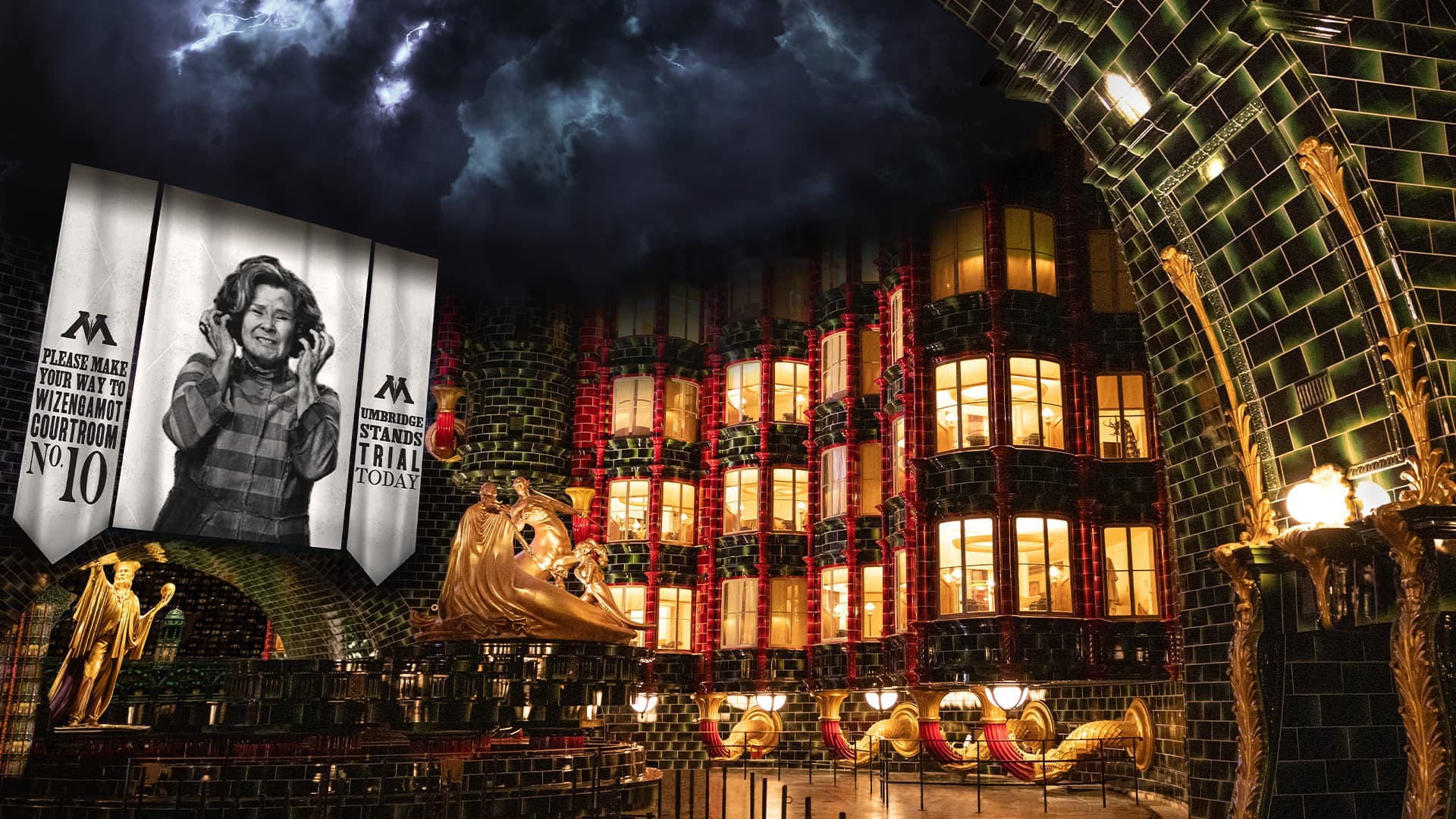
But it was the other half of the land that captured the most attention: the Ministry of Magic itself. After queuing through a section of Place Cachée, guests would board the Métro-Floo, which took them into the towering atrium of the British Ministry as it appeared in the Harry Potter films. The atrium featured iconic green tilework, golden statues, and soaring fireplaces for Floo Network travel. Universal Creative worked closely with Warner Bros. and the Harry Potter film team to faithfully recreate the look and feel of the Ministry, including Umbridge’s signature pink office, Auror workspaces, and departments dealing with magical law enforcement and creature regulation.
At the heart of this section was the new marquee attraction: Harry Potter and the Battle at the Ministry. Unlike previous rides in the Wizarding World, this one took place after the events of the books and films. The story began with Dolores Umbridge facing trial for her post-Hogwarts crimes, only to escape using dark magic. Guests were recruited to help recapture her, joining forces with Harry, Ron, and Hermione, as well as a new character—a house-elf named Higgledy, who provided comic relief and magical assistance along the way.
The ride system itself marked a major technological leap forward for Universal. Described as an “omnidirectional lift” system, it combined the sensation of an elevator with trackless dark ride motion, allowing vehicles to move up, down, sideways, and even rotate in place. The result was a seamless blend of physical sets, screen-based effects, and animatronics, creating one of the most complex and thrilling attractions Universal had ever produced. Guests found themselves battling Death Eaters, dodging magical spells, and soaring through the Ministry’s various chambers, culminating in a final confrontation that sent shockwaves through the courtroom.
Throughout the ride’s queue, attention to detail remained paramount. Guests passed through the Hall of Ministers, where portraits and magical busts lined the walls. Umbridge’s office featured moving objects and enchanted quills, while the Auror command center pulsed with activity. The queue wasn’t just a line—it was an immersive environment that deepened the narrative before the ride even began.
Universal’s decision to set the story after the original books and films allowed for creative freedom while maintaining ties to the established canon. Bringing back characters like Umbridge, with the amazing Imelda Staunton reprising her role, lent authenticity and continuity, while the addition of new figures like Higgledy expanded the universe in small but meaningful ways. This careful balance between innovation and fidelity is what has made the Wizarding World lands so beloved, and the Ministry of Magic is perhaps the best expression of that philosophy yet.

Creating the Ministry was not simply a matter of building a ride or theming a street. It was a process that required Universal to weave together two different eras of the Wizarding World—the 1920s of Fantastic Beasts and the late 1990s of Harry Potter—into a single cohesive land. The thematic handoff between Paris and London, the blending of magical transportation concepts, and the layered storytelling required to make it all feel natural demanded years of creative development. The team behind Epic Universe worked closely with the filmmakers and production designers to ensure every detail felt consistent with the source material, and the result is a land that feels like a true continuation of the Wizarding World, not just an imitation.
What makes this land so unique is that it isn’t just content to replicate what fans have already seen. It pushes forward, offering new stories, new characters, and new magical experiences while grounding everything in the visual language and narrative traditions of the franchise. Every corner is packed with nods for fans, but it never relies solely on nostalgia. Instead, it invites guests to participate in the world, to help shape its unfolding history.
In many ways, the Ministry of Magic represents the future of theme park storytelling. It’s not just a place to visit—it’s a world to enter, a story to inhabit. With this land, Universal has built something that feels less like a theme park expansion and more like an extension of a beloved universe. For fans of Harry Potter and Fantastic Beasts alike, it is the most ambitious realization of the Wizarding World yet, and a sign of what’s possible when theme park design fully embraces narrative depth, technological innovation, and cinematic partnership.