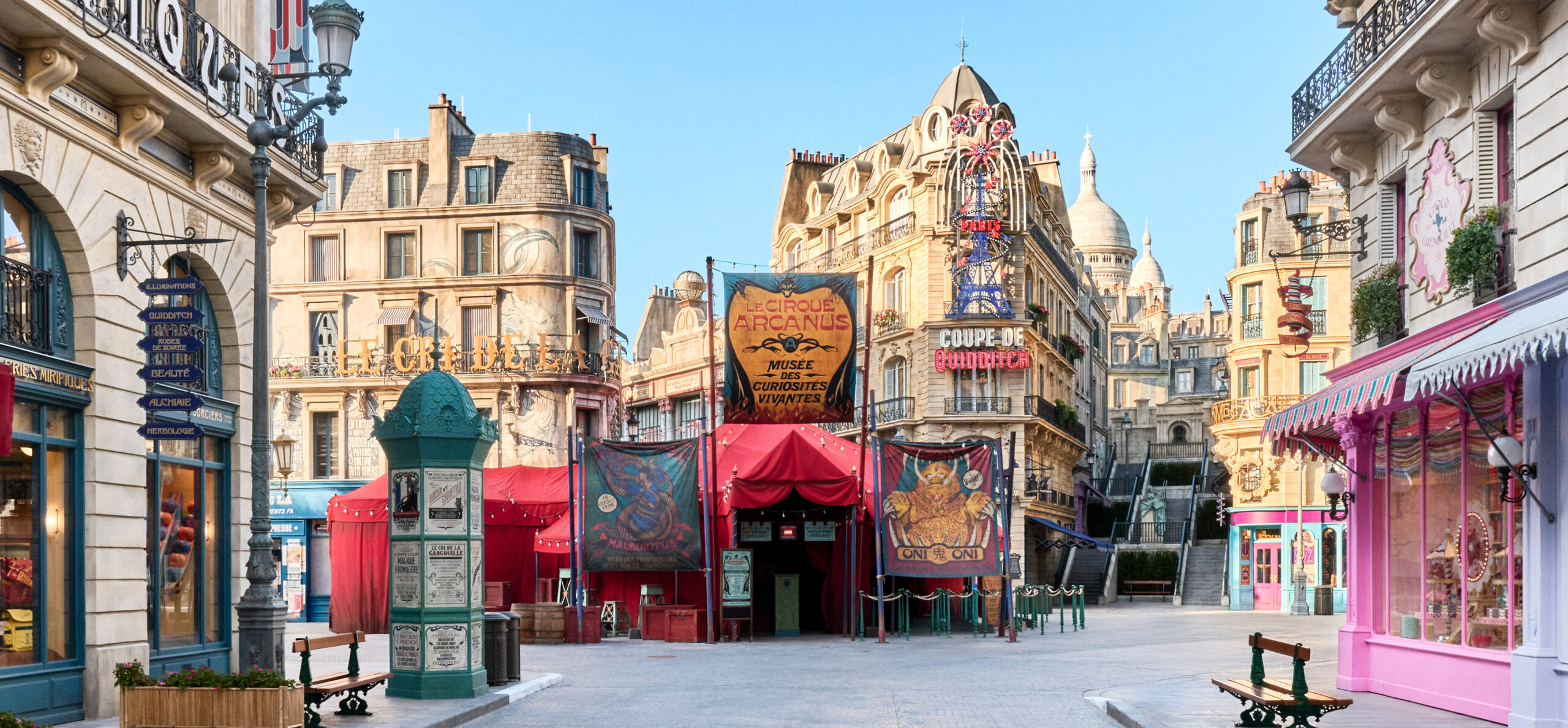
Universal Orlando’s Epic Universe has ushered in a new chapter in immersive theme park storytelling with its recreation of Wizarding Paris. This stunning land invites guests to step into the 1920s world of Fantastic Beasts, fully realized through intricate design that blends magical fantasy with the real architectural, cultural, and artistic history of early twentieth century France. While the area dazzles with spell-casting spots and enchanting storefronts, it also stands as a sophisticated homage to the cultural richness of historic Paris. Wizarding Paris is more than a backdrop for wand battles—it is a love letter to French heritage and artistic movements through the lens of J.K. Rowling’s expanding universe.
A Magical Take on 1920s Paris
When guests pass through the portal gates into the land, they find themselves transported to 1920s Paris—a time of flappers, jazz, avant-garde cinema, and the cultural boom of the post-war era known as les Années folles. Universal’s design team has avoided clichés and instead leaned into a stylized, magical version of Paris filtered through historical realism. The setting reflects the Paris of bohemian enclaves and creative explosion, not the postcard version.
This attention to period detail is no accident. Every element of the land—from signage to street lamps—is steeped in early twentieth century artistic influence, particularly that of Art Nouveau, a movement known for its flowing lines, organic forms, and integration of natural motifs. Café L’air De La Sirène, with its swirling mosaics and fluid ironwork, reflects the work of artists like Hector Guimard, the architect behind Paris’s iconic Metro entrances. His aesthetic fingerprints can be seen in the curling signage and decorative flourishes throughout Wizarding Paris.
Art Nouveau and the Magic of Design
Art Nouveau (c. 1890–1910) was more than a design trend. It was a complete artistic philosophy aimed at unifying art and life. Artists and architects sought to bring beauty into daily experience through natural forms, curved lines, and intricate detail. In Wizarding Paris, this philosophy is evident in shopfronts with asymmetrical windows, winding staircases, and iron balcony railings. These design choices do not simply evoke a time period—they root the land in a real historical movement, giving weight to its fantasy.

Even the park’s color palette—muted pastels, faded golds, deep greens—reflects the tones of Belle Époque poster art, such as the lithographs of Alphonse Mucha and Jules Chéret. Many of the land’s graphic design elements, including vintage-style posters for Le Cirque Arcanus, draw directly from their legacy. For fans of themed design, this level of historical texture provides a rare artistic coherence.
Place Cachée: Layers of Time
The land’s central market and alleyway area, known as Place Cachée (“hidden place”), functions as the French counterpart to Diagon Alley. The district mimics the clustered, organic layout of historic Parisian neighborhoods like Le Marais, where centuries of architecture press up against one another in winding, uneven fashion. The deliberate lack of symmetry, slanted rooftops, and layered stonework gives the illusion of a secret world built beneath the Muggle surface.
Just like in real-world Paris, where modern boutiques stand beside medieval cathedrals, Place Cachée captures the feeling of a city grown over time. The design draws from authentic urban planning rather than stagecraft, reinforcing the sense of a living, magical community.
The Gobelet Noir and the Alchemy of Atmosphere
Not every corner of Wizarding Paris glitters with polished tile and gilded signs. Le Gobelet Noir, a medieval-style tavern known to attract witches and wizards of questionable intent, provides a stark contrast. With rough stone walls, timber beams, and flickering lanterns, it feels much older than the rest of the land—a relic of a darker age. This use of contrasting architectural style not only deepens the immersive quality but also echoes real Parisian history, where layers of time coexist.
Adding another layer of historical authenticity is the inclusion of Nicolas Flamel’s home. Flamel, a real 14th-century Parisian scribe and bookseller, has long been associated with alchemy and the Philosopher’s Stone. His legacy in both real-world legend and magical fiction makes his residence an ideal anchor for the land. Rather than inventing an imaginary space, Universal chose to incorporate a figure who straddles myth and history, further grounding the land in believable magic.
Le Cirque Arcanus and the Belle Époque Spectacle
The magical circus Le Cirque Arcanus, introduced in Fantastic Beasts: The Crimes of Grindelwald, comes to life here as a traveling sideshow steeped in eerie wonder. Its design draws from Belle Époque circus traditions: rich velvet tents, painted wagons, grotesque puppetry, and ornate calligraphy. Guests will recognize elements inspired by historical European circuses, where the line between spectacle and shadow was deliberately blurred. The circus adds texture to the world not only through character interaction but through its historically grounded visuals.

Design as Storytelling
Posters advertising magical events are written entirely in French and printed in styles reminiscent of 1900s poster art—some clearly modeled after works by Mucha or Chéret. These are not generic props. They are layers of story, filled with jokes, references, and even clues for the attentive explorer. Typography, color theory, and vintage printing techniques all serve the worldbuilding.
The shop windows display a French-language edition of Fantastic Beasts and Where to Find Them by Newt Scamander. This localization not only supports the story’s setting, it reflects the real-world publishing practice of translating major works into local markets. A mundane reality made magical.
A Living World of Layers
Wizarding Paris is not just a themed land—it is a historical collage. With every alley and lamppost, it evokes the art, architecture, and spirit of the time between World War I and the rise of modernism. Universal’s designers have taken their cues from the real world to shape something that feels timeless and mysterious.
There is no need for an Eiffel Tower here. The identity of France is alive in the wrought iron scrolls, the layering of centuries, the echoes of Flamel, and the shadows cast by circus tents. Universal has delivered not only a faithful Wizarding World experience, but a themed environment that understands its cultural DNA.
In a theme park industry that increasingly strives for deeper immersion and storytelling, Wizarding Paris sets a new benchmark. It shows that magic is most powerful when it is grounded in something real—a style, a time, a myth. Through its use of historical art and architecture, Epic Universe’s Wizarding Paris becomes more than fantasy. It becomes cultural memory made tangible.