On June 23, 1963, a small tropical theater tucked away in the corner of Disneyland’s Adventureland quietly made history. It didn’t open with the fanfare of a new castle or parade, but those lucky enough to step inside Walt Disney’s Enchanted Tiki Room that day witnessed something revolutionary.
For the first time ever, guests were entertained by dozens of robotic performers — birds, flowers, tikis, and totems — all singing and speaking in perfect unison. The show was immersive, whimsical, and charming. But more importantly, it marked the debut of a groundbreaking technology that would forever reshape themed entertainment: Audio Animatronics.
And believe it or not, it all started with a single mechanical bird.
A Curious Bird in New Orleans
Walt Disney often said, “It all started with a mouse,” referring to the birth of Mickey and the empire that followed. But the history of Disney’s most enduring innovation — lifelike robotic figures — begins not with animation cels or theme park blueprints, but in an antique shop in New Orleans.
Sometime in the 1940s, while on vacation with his wife Lillian, Walt stepped into a little store in the French Quarter. There, he discovered a mechanical songbird housed in a gilded cage. It chirped through a hidden bellows, turned its head, and opened its beak in sync. The bird was likely built by Bontems of Paris, a renowned maker of such automata.
Walt was fascinated.

To most people, it was just a quaint novelty. But to Walt, who had spent decades animating life on film, this was a tangible new kind of animation — something real, something that moved in three dimensions. He brought the bird back to Burbank and handed it to his studio technicians, asking them to take it apart and figure out how it worked.
This moment would become the Big Bang of Audio Animatronics.
Building a New Kind of Animation
Walt’s team of Imagineers — a blend of artists, engineers, and tinkerers — studied the bird’s mechanics and began experimenting. The idea was simple: if a small figure could mimic a bird’s motion, what else could be done?
Sculptor Charles Cristadoro modeled human heads using Buddy Ebsen and other studio employees as reference. Engineers explored cams, hydraulics, and other motion techniques. One early concept involved a talking Confucius figure for a Chinese-themed restaurant in Disneyland — a project that never materialized.
But the technology kept improving. Soon, Walt challenged his team to build an entire attraction filled with singing birds. That challenge became the Enchanted Tiki Room.
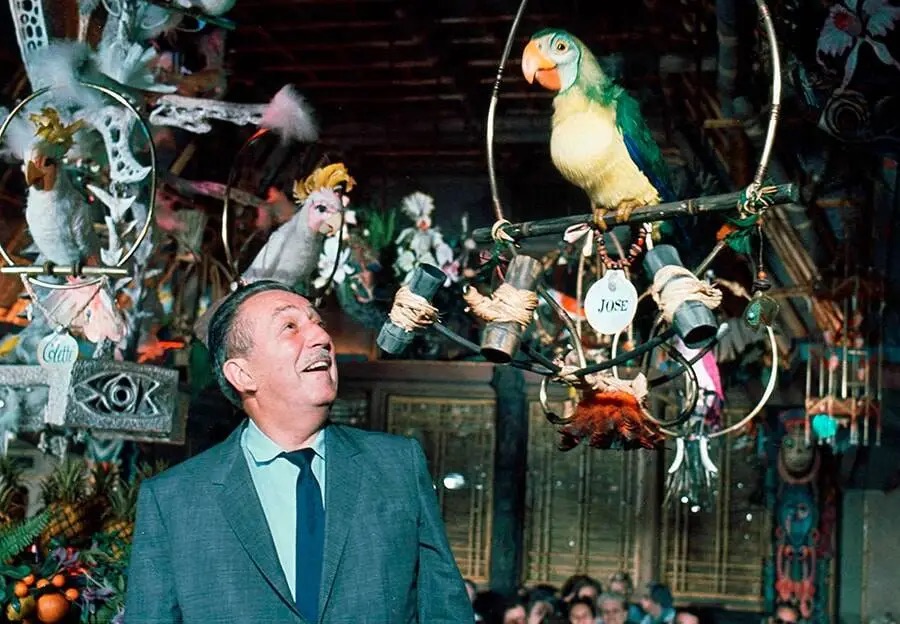
When it opened in 1963, it was the first fully air-conditioned building in Disneyland, designed to keep the delicate systems cool. The show featured over 150 Audio Animatronic figures, each carefully programmed to deliver movement in sync with a prerecorded soundtrack. At the time, it was operated using a massive room-filling computer — a marvel of engineering for the early 1960s.
It was, in every sense, a first-of-its-kind experience.
The Tiki Room Takes Flight
Unlike traditional stage performances, the Tiki Room surrounded guests with action. Birds perched on rafters above. Flowers bloomed and harmonized. Tiki gods came to life and joined in. And at the center were four parrots — José, Michael, Pierre, and Fritz — who hosted the show with charming accents and synchronized comic timing.
Audiences were enchanted. More than just a gimmick, the Tiki Room proved that robotic figures could tell stories, deliver jokes, and sing in character. Walt had found a new storytelling language — one that blurred the lines between animation, theater, and engineering.
But he wasn’t done yet.
Animatronics at the World’s Fair
The real explosion came the following year at the 1964–65 New York World’s Fair, where Disney introduced several new attractions, all of which leaned heavily on Audio Animatronics.
Great Moments with Mr. Lincoln debuted to critical acclaim, featuring a lifelike Abraham Lincoln that could rise from a chair, gesture while speaking, and recite the Gettysburg Address. It was a technological leap beyond the birds of the Tiki Room — and audiences were stunned.
Also featured were it’s a small world, with hundreds of singing children from around the globe, and Carousel of Progress, a rotating theater chronicling the evolution of modern life. These attractions would eventually be relocated to Disneyland and Walt Disney World, cementing the importance of Audio Animatronics in Disney parks.
From A1 to A1000: The Evolution
The earliest Audio Animatronics from the Tiki Room and World’s Fair are now known as A1 models. They moved using pneumatic and hydraulic systems and could only perform simple binary motions: move arm up, move arm down. There was no fluidity, no nuance.
Still, Disney’s Imagineers kept pushing. Over the decades, new generations of figures emerged. In 1989, with the debut of The Great Movie Ride at Disney-MGM Studios, Disney introduced the A100 model — most famously the Wicked Witch of the West. She moved with unprecedented realism, thanks to electrical compliance and refined controls.
In 2016, Frozen Ever After at Epcot became the first attraction to use all-electric Animatronics, allowing for smoother, quieter, and more precise motions. No more hissing hydraulics — just lifelike characters that blinked, emoted, and sang with near-human range.
And in 2019, the bar was raised again with the introduction of A1000 figures in Star Wars: Galaxy’s Edge. These figures brought even greater expressiveness and subtlety to characters like Hondo Ohnaka, who interacts with guests in real time.
The Latest Chapter: Tiana’s Bayou Adventure
In 2025, the story continues with Tiana’s Bayou Adventure, where Disney has taken A1000 technology and plussed it again. The ride features multiple versions of Princess Tiana, each with incredible facial animation, as well as a towering, trumpet-playing Louis the alligator and a cast of all-new critter characters.
The dream that started with a simple automaton bird in a cage now gives life to fully realized, expressive characters who can laugh, dance, and even cry.

More Than Machines
To this day, Walt Disney Imagineering refers to their Audio Animatronics as “electronic actors.” These figures perform thousands of times a day, delivering their lines with consistency and precision — and helping millions of guests suspend their disbelief.
They aren’t just machines. They’re part of the storytelling fabric.
As Brian Orr of Walt Disney Imagineering put it:
“To take that and continue with that process, from little bluebird there to giant green, fully expressive character, believable, belly shaking — I mean, it’s magic.”
And it all started with a bird.