If you’ve ever walked through the entrance of Disney’s Animal Kingdom, you might have noticed something strange. Above the main gate, carved alongside majestic real-world animals like elephants and antelopes, is the head of a dragon.
It’s a subtle detail. Most visitors probably never question it. But that dragon doesn’t match anything else in the park. There’s no dragon-themed ride, no medieval castle, no fire-breathing animatronic hiding in the trees.

So what is it doing there?
That dragon is a ghost. A remnant of a land that Disney started planning, partially designed, and then canceled before the park opened. It was called Beastly Kingdom, and it would have introduced unicorns, griffins, and a massive, mythic roller coaster through a dragon’s lair.
But here’s the twist: while Disney shelved the idea, a team of former Imagineers took the concept across town to Universal. And Universal built it.
This is the wild story of how Disney’s mythical dragon coaster died… and was reborn as one of Universal’s most iconic rides.
The Original Vision for Animal Kingdom and the Role of Beastly Kingdom
When Disney set out to build Animal Kingdom in the early 1990s, the concept was bolder than most people realize. Yes, it was going to be a park about animals, but not just real animals.
The original pitch divided the animal world into three categories:
- Real animals like tigers, elephants, and giraffes
- Extinct animals like dinosaurs
- Mythical animals like dragons, unicorns, and griffins
You can still see this idea in the original Animal Kingdom logo, which includes a dinosaur and a dragon right alongside a lion and an elephant. The park was envisioned as a celebration of all creatures from nature, history, and imagination.

To fulfill the “mythical” part of the vision, Disney planned a full land called Beastly Kingdom. It would be nestled deep within the park, made up of lush forests, dark castles, and magical creatures brought to life through state-of-the-art technology.
This wasn’t just fantasy for fantasy’s sake. Beastly Kingdom was meant to explore how mythology reflects our relationship with nature and how ancient cultures used stories to understand the world around them. Dragons weren’t just monsters; they were symbolic, mysterious, and powerful.
Beastly Kingdom was going to be Animal Kingdom’s answer to Fantasyland but darker, more intense, and geared toward teens and adults. It would house two main areas: one light and whimsical, one dark and dangerous.
On the light side, guests would explore a Unicorn-themed hedge maze and a boat ride inspired by Disney’s Fantasia, full of dancing hippos, crocodiles, and surreal classical music scenes.
But it was the dark side that Imagineers were most excited about. That’s where the dragon lived.
Disney’s Forgotten Fire-Breather Coaster
At the center of Beastly Kingdom’s dark side was a grand, crumbling castle. The lair of a massive fire-breathing dragon. Inside that castle, guests would find one of Disney’s most ambitious thrill rides ever: Dragon Tower.
Dragon Tower was conceived as a hybrid coaster and dark ride, something unlike anything Disney had built before. The story was that you were part of a band of adventurers sneaking into the ruins to steal from the dragon’s treasure hoard.
Of course, things go horribly wrong.
The dragon awakens. Flames shoot out. The castle starts shaking. And your only escape is a high-speed roller coaster through its smoldering ruins.

The ride would have featured elaborate animatronics, fire effects, smoke, shadows, and a dramatic chase scene where the dragon hunted you through winding corridors and collapsing towers.
Think Indiana Jones Adventure meets Expedition Everest, but even more immersive and mythic in tone. The queue would wind through the ruined castle, past dragon skeletons and glowing treasure, before loading into ride vehicles designed to look like armored carts or enchanted wagons.
Imagineers wanted Dragon Tower to be the E-ticket attraction that gave Animal Kingdom a darker, more thrilling side, balancing out the natural beauty and conservation themes with something bold and fantastical.
But then… it was suddenly canceled.
The Universal Connection: How Disney’s Dragon Ended Up Across Town
As Animal Kingdom’s construction moved forward in the mid 1990s, Disney faced tough budget choices. Costs were rising, and something had to be cut. The company made a strategic decision: instead of building Beastly Kingdom, they would invest in DinoLand U.S.A., which could tie in with their upcoming film Dinosaur.
Beastly Kingdom was postponed. Then shelved. Then scrapped entirely.
Many of the Imagineers who had worked on it were reassigned or left the company disillusioned after pouring their hearts into a land that never materialized.
But over at Universal, a brand-new park was in development: Islands of Adventure. And Universal needed creative talent fast.
They hired several former Disney Imagineers, including those who had worked on Beastly Kingdom. And those Imagineers had ideas.
Specifically: dragons.
While Disney had abandoned the concept, the core idea — a mythical, medieval-themed roller coaster — was still alive in the minds of its original creators. And Universal gave them the freedom (and the budget) to bring it to life.
In 1999, just one year after Animal Kingdom opened without Beastly Kingdom, Universal’s Islands of Adventure opened with a ride that looked suspiciously familiar…
Dueling Dragons: Beastly Kingdom’s Spiritual Successor
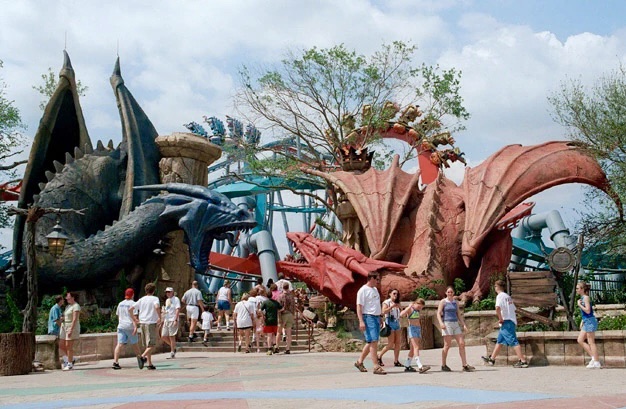
Dueling Dragons was one of the original headliners at Islands of Adventure. It featured two massive, intertwined roller coasters, each themed to a different dragon: Fire and Ice.
Guests would choose a side and board their dragon. The two coasters launched separately but converged in a series of precision-timed near misses, where trains flew past each other at terrifying speed, just inches apart.
It wasn’t just a coaster. It was a full experience.
The queue was a burned-out castle filled with scorched stone, shattered stained glass, and twisted iron gates. Along the way, guests passed dragon bones, burned banners, and ominous carvings. It was moody, immersive, and mythic. Exactly the tone Beastly Kingdom’s dark side was going to strike.
No, it wasn’t an exact copy. Universal didn’t steal anything illegal. But thematically? Spiritually? Dueling Dragons was Dragon Tower reincarnated.
In a strange twist of fate, Universal — often seen as the scrappy underdog — managed to out-Disney Disney by building the dragon ride Disney had been too cautious to pursue.
And fans loved it.

The ride ran until 2017. It was briefly re-themed as “Dragon Challenge” for the Harry Potter expansion, and later replaced by Hagrid’s Magical Creatures Motorbike Adventure — another phenomenal ride, but one that abandoned the medieval dragon vibe.
Even now, longtime fans still miss the original Dueling Dragons, not just because of the thrill, but because of what it represented: a bold creative idea that rose from the ashes of cancellation and found a home in a rival park.
Want More Stories Like This?
The story of Beastly Kingdom and Dueling Dragons is one of the most fascinating in theme park history. A rare case where a Disney concept was lost, only to be reborn at Universal by the very people who dreamed it up.
It’s a reminder that great ideas don’t always die. Sometimes, they just fly off to greener pastures… or in this case, burn their way across town.
If you love stories like this, forgotten lands, lost rides, creative rivalries, and behind-the-scenes magic, we’ve got so much more to share.
Subscribe to “We Love Attractions” on YouTube for deep dives into theme park history, extinct attractions, hidden details, and all the incredible ideas that never made it past the planning stage.